-
From Theory to Plan: Translating Principles into Lessons32 Topics
-
Active Learning Strategies44 Topics
-
Differentiation and Personalized Learning5 Topics
-
Formative Assessment: Techniques and Use4 Topics
-
Classroom Management: Routines, Procedures and Environment5 Topics
-
Collaborative Learning and Group Work6 Topics
-
Questioning, Feedback and Scaffolding5 Topics
-
Technology Integration and Digital Activities6 Topics
-
Inclusive Practices: Equity, ELL and SEN Strategies7 Topics
-
Reflection, Action Research and Professional Growth4 Topics
Participants 3

Lesson structure (minute-by-minute)

didactec 28.11.2025
Lesson Progress
0% Complete
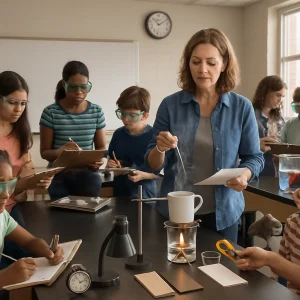
0:00–0:05 — Motivation (5 min)
- Teacher script (concise, real-life hook): “Today you’ll learn three ways heat moves. Why does a metal spoon get hot in a mug of tea but a wooden spoon doesn’t? Why does warm air rise above a heater? These ideas explain everything from cooking to home insulation.”
- Show 30–60 second clip or a close-up photo sequence of real-life examples (tea spoon, convection in boiling soup, sunlight warming pavement).
- Post the learning objective and why it matters in plain language. Ask one quick diagnostic question: “Which of these have you noticed before — conduction, convection, radiation?” (thumbs-up / show of hands) — 30 seconds.
0:05–0:15 — Direct teaching + short demonstration (10 min)
- Teach (5 min): 2–3 clear definitions with one-sentence examples.
- Conduction: energy transfer through direct contact (metal spoon in hot water).
- Convection: energy transfer by bulk movement of fluid (warm air/water rising).
- Radiation: transfer by electromagnetic waves (sunlight warming skin).
- Demonstration (5 min): Conduct a quick conduction demo:
- Place a small dab of wax or a paperclip on the end of a metal rod that extends from a beaker of hot water. Watch the wax melt / paperclip drop as heat travels along the rod.
- While demo runs, ask 2 quick formative questions: “Where did the energy start? How did it get to the other end?” Students jot a one-sentence prediction.
- Connect demo to stations: “You’ll rotate through three stations to observe each transfer in more depth and collect evidence.”
0:15–0:35 — Active practice: Rotating stations (20 min)
- Organization: 3 stations, groups of 3–4. Each group spends ~6 minutes at a station, with 1 minute to rotate. (Timing: Station 1 = 6 min, rotate 1 min; Station 2 = 6 min, rotate 1 min; Station 3 = 6 min, return 0–1 min buffer).
- Roles per group (assign): Recorder, Timekeeper/Materials manager, Lead experimenter, Reporter (rotates each station).
- Each station card includes:
- Quick objective (what to observe)
- Procedure (3–5 steps)
- Data / observation prompts
- Guiding questions (for deeper thinking)
- Safety notes
Station A — Conduction (sample card)
- Procedure (3 steps): 1) Place an ice cube on a metal vs wooden strip. 2) Touch both strips carefully (or use IR thermometer) and time melting. 3) Record which melts faster and temperatures.
- Guiding Qs: Which material conducts heat faster? What property of a material explains this (metal vs wood)? How would you reduce conduction in a pot handle?
- Safety: use gloves for hot items.
Station B — Convection
- Procedure: 1) Add hot water to one side of the clear container & cold to the other (or heat one region gently). 2) Add dye to visualize flow. 3) Record movement patterns and temperature changes.
- Guiding Qs: Where does warm water go? How does movement carry energy? What everyday system uses convection?
- Safety: handle hot water carefully.
Station C — Radiation
- Procedure: 1) Place black and white squares at equal distance from a lamp for 3 minutes. 2) Measure surface temperature changes with IR thermometer/probe. 3) Apply/shield and repeat.
- Guiding Qs: Which square warmed more? What does color or surface tell you about radiation absorption? How can we use this to design a solar cooker or keep houses cool?
- Safety: don’t look directly at lamp; manage cords.
Teacher moves during stations
- Circulate rapidly — 1–2 minutes per group check-in: ask a probing question, check data recording, correct misconceptions, model brief scientific talk (60–90 seconds).
- Use a checklist to capture formative evidence (are students making observations, using terms correctly, producing appropriate explanations).
0:35–0:43 — Synthesis activity: Claim–Evidence–Reasoning (8 min)
- Structure (group → pair → whole): Each group crafts one short CER statement comparing the three modes, including one real-life application (2–3 sentences).
- Claim: “Energy is transferred by conduction, convection and radiation; in our station, …”
- Evidence: cite 2 precise observations (temperatures, times, dye flow, relative warming of surfaces).
- Reasoning: connect evidence to claim using scientific principle.
- Quick share: have 2–3 groups present their CER (30–45 seconds each). Teacher posts key phrases on board.
0:43–0:48 — Reflection & formative assessment (5 min)
- Use either:
- 3–2–1 exit ticket (students individually write):
3 things I learned, 2 real-life connections, 1 question I still have. - OR Information ladder quick form:
After this lesson I: 1) know __ 2) understand __ 3) can use __ 4) noticed __.
- 3–2–1 exit ticket (students individually write):
- Collect exit tickets (paper or digital).
0:48–0:50 — Closure & homework (2 min)
- Teacher closure: Summarize 2 key takeaways and correct any common misconceptions noted during circulation.
- Assign homework (brief & purposeful): Short applied task — “Take a photo at home of an example of conduction, convection or radiation. Label which mode and write one-sentence justification.” (Kept short to support transfer to real life.)