Back to Course
AA Top Teacher Theory vol 2_1: Classroom Activities
0% Complete
0/0 Steps
-
From Theory to Plan: Translating Principles into Lessons32 Topics
-
(A) From Theory to Lesson Plans
-
1. One-Page Lesson Plan Template (fillable)
-
2. Lesson Structure and Timing — Practical Rules of Thumb
-
3. Mapping Theory to Plan — How to Translate Constructs into Steps
-
4. Sample: Filled Lesson Plan (60 min) — Calculating Combinations (no probabilities)
-
5. Formative Question Bank (quick checks to map to objective & ZPD)
-
6. Quick Teacher Checklist — Before, During, After
-
7. Practical Tips & Pitfalls (12 + concise cautionary notes)
-
8. Short theoretical mapping (why this works)
-
9. Short Rubric Example (for counting/permutation lesson)
-
(B) Learning Objectives and Outcomes
-
1. Principles: What makes a good objective
-
2. Translate objectives into student‑friendly outcomes
-
3. Checklist for writing objectives & outcomes
-
4. Mapping objectives to the lesson structure
-
5. Worked example — 9th‑grade biology lesson
-
6. Quick teacher templates
-
7. Common pitfalls and how to avoid them
-
8. Final checklist before you teach
-
(C) Sequencing & Pacing
-
Micro‑sequence: the lesson template (for ~60-minute lesson)
-
Macro‑sequence: mapping a two‑week unit
-
Two‑week (10 × 60‑minute) pacing guide — ready to adapt
-
Justifying method choice (how to explain to students / why they’re doing it)
-
Monitoring progress & adjusting pace (practical cues)
-
Quick checklist for teachers (before each lesson)
-
Practical Example: 45-minute Lesson Plan
-
(D) Differentiation & Inclusion Strategies (summary)
-
Assessment & Checks for Understanding
-
Extensions & Cross‑Curricular Ideas
-
Common Student Errors & Teacher Prompts
-
Teacher Notes / Script Highlights (select phrases you might say)
-
(A) From Theory to Lesson Plans
-
Active Learning Strategies44 Topics
-
(A) Think-Pair-Share and Variants
-
Core TPS structure (teacher-script + timing)
-
Designing productive pairwork
-
Practical classroom workflow that connects to your lesson context
-
Follow-up TPS for generalization (Think–Pair–Share leading into theory):
-
Formative assessment and feedback strategies for TPS
-
Managing time and flexibility
-
Classroom materials and tech (checklist)
-
Appendix: Quick lesson-plan entry for a TPS activity (copy into your OneNote tab)
-
(B) Problem-Based Learning (PBL) Basics
-
Short PBL tasks for single lessons (ready to use)
-
60‑minute Civic Education PBL: Full scenario — “Community Green Space: Whose Priorities?”
-
Teacher preparation checklist (quick)
-
Good practice tips & pitfalls
-
(C) Hands-on and Manipulative Activities
-
Example 1 — Fractions: Building Equivalence, Addition and Comparison with Manipulatives
-
Example 2 — Physics: Motion Labs with Simple Materials (displacement, velocity, acceleration)
-
Classroom roles, group routines, and scalability
-
Assessment strategies (formative and summative)
-
Reflection protocols and consolidation
-
Quick templates you can copy
-
Practical teacher tips
-
(D) Simulations & Roleplay
-
Low-prep simulations (fast, scalable)
-
Assessment: formative rubric (sample)
-
Debrief & reflection (mandatory)
-
Sample roleplay: Mock Trial (classroom-ready template)
-
Practical tips & teacher moves
-
(E) Stations, Rotations and Learning Centers
-
Classroom routines and management
-
Station instruction template (one card for students)
-
Assessment checkpoints: formative and summative
-
Differentiation and supports (mixed-ability groups)
-
Full example: STEM rotation for mixed-ability groups
-
Sample short assessment checklist (station-level, teacher uses)
-
Monitoring, correcting progress, and feedback routines
-
Reflection, evaluation and closure
-
Teacher checklist before first run
-
(F) Practical Example: Active Lesson Sequence
-
Lesson structure (minute-by-minute)
-
Formative assessment & success criteria
-
Differentiation & accessibility
-
Classroom management & logistics tips
-
Teacher reflection prompts (post-lesson)
-
(A) Think-Pair-Share and Variants
-
Differentiation and Personalized Learning5 Topics
-
Formative Assessment: Techniques and Use4 Topics
-
Classroom Management: Routines, Procedures and Environment5 Topics
-
Collaborative Learning and Group Work6 Topics
-
Questioning, Feedback and Scaffolding5 Topics
-
Technology Integration and Digital Activities6 Topics
-
Inclusive Practices: Equity, ELL and SEN Strategies7 Topics
-
Universal Design for Learning (UDL) in Practice
-
Accommodations vs Modifications
-
Supporting English Language Learners (ELLs)
-
Strategies for Students with Special Educational Needs (SEN)
-
Culturally Responsive Teaching
-
Behavior Support Plans and Positive Interventions
-
Practical Example: Inclusive Lesson for ELL and SEN Learners
-
Universal Design for Learning (UDL) in Practice
-
Reflection, Action Research and Professional Growth4 Topics
Participants 3

Lesson Progress
0% Complete
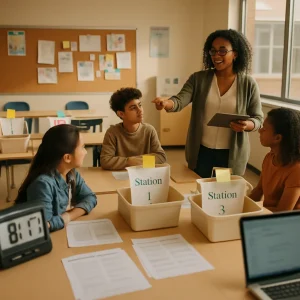
- Clear competence goal written and student-friendly.
- Station cards printed or uploaded.
- Materials prepared and in station bins (labeled).
- Timer and transition signal ready.
- Assessment checkpoints and rubrics printed or digital.
- LMS folder ready for uploads.
- Grouping plan decided and explained to students.
- Safety rules posted.
- Plan for reteach mini-station ready.
Final practical advice
- Explain the method and your justification to students at the start — tell them exactly how to act and what successful work looks like.
- Monitor actively, give corrective feedback in the moment, and collect evidence of learning.
- Break down problems with whole-class or targeted conversations when misconceptions arise.
- Always evaluate together: What was learned? How did the method feel? What should we clarify?
- Document outputs (photograph, scan flipchart notes) and make them visible to students (LMS or shared wall).
- Be bold and try new station designs — but be patient. Each new method should be practiced at least four times before judging its effectiveness.
Use the templates in this topic to create your own station cards, checkpoint rubrics and rotation schedules. Stations scale: use 3–6 stations for single lessons; use multi-lesson rotations for project-based units. Apply, adapt, and iterate — active learning through stations will transform practice when combined with clear goals, structured assessment checkpoints, and firm classroom routines.