-
From Theory to Plan: Translating Principles into Lessons32 Topics
-
Active Learning Strategies44 Topics
-
Differentiation and Personalized Learning5 Topics
-
Formative Assessment: Techniques and Use4 Topics
-
Classroom Management: Routines, Procedures and Environment5 Topics
-
Collaborative Learning and Group Work6 Topics
-
Questioning, Feedback and Scaffolding5 Topics
-
Technology Integration and Digital Activities6 Topics
-
Inclusive Practices: Equity, ELL and SEN Strategies7 Topics
-
Reflection, Action Research and Professional Growth4 Topics
Participants 3


Lesson Progress
0% Complete
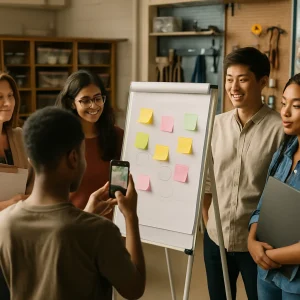
- Group debrief (5–10 min): Each group gives a 60–90 second summary: What we did, what worked, one key learning, and next step.
- Class reflection prompts (use one):
- 3–2–1: 3 things learned / 2 real‑world connections / 1 question left
- Information ladder: I know __ ; I understand __ ; I can use this __
- Document oral outputs: write summary on flipchart, photograph, and upload.
- Homework: short reflective task that connects station learning to future work (e.g., revise sketch using lessons learned).
Troubleshooting common issues
- Slow transitions — rehearse and shorten station tasks or increase the number of rotations.
- Dominant student monopolizes task — assign rotating roles and require each role’s artifact (e.g., recorder must sign the log).
- Materials shortage — build “material bank” and a borrowing protocol; have a mini-station for repairs.
- Groups finish early — prepare extension tasks or a “challenge” card at each station.
- Low motivation — give clear justification (tie to competence goals/real-life use), and ensure outcomes are visible and shareable.
Safety, ethics and documentation
- Explicitly post safety rules at STEM/tech stations; require PPE when necessary.
- Make sure photos or uploads respect privacy policy and parental consent for student images.
- Keep “clean copies” of oral work (flipchart photos, typed summaries) for inclusion in portfolios.