-
From Theory to Plan: Translating Principles into Lessons32 Topics
-
Active Learning Strategies44 Topics
-
Differentiation and Personalized Learning5 Topics
-
Formative Assessment: Techniques and Use4 Topics
-
Classroom Management: Routines, Procedures and Environment5 Topics
-
Collaborative Learning and Group Work6 Topics
-
Questioning, Feedback and Scaffolding5 Topics
-
Technology Integration and Digital Activities6 Topics
-
Inclusive Practices: Equity, ELL and SEN Strategies7 Topics
-
Reflection, Action Research and Professional Growth4 Topics
Participants 3

Sample roleplay: Mock Trial (classroom-ready template)

didactec 28.11.2025
Lesson Progress
0% Complete
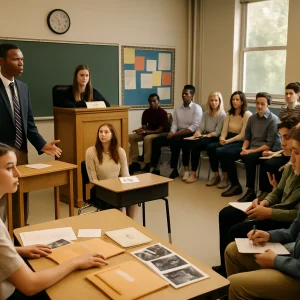
Purpose: practice persuasive reasoning, evidence evaluation and formal oral argument.
Time: 60–75 minutes (adaptable)
Materials: role cards, evidence slips, witness statements, verdict form, timer
Roles (example for a civic / language class):
- Judge (1) — keeps order, enforces time limits, reads verdict form.
- Prosecutor team (2–3) — presents case, calls witnesses, cross-examines.
- Defence team (2–3) — defends accused, cross-examines.
- Defendant (1) — may testify.
- Witnesses (2–4) — read prepared statements; optional improv answers under cross-exam.
- Jury (4–6) — listens, deliberates, returns verdict (binding for classroom).
- Clerk / Evidence manager (1) — organizes evidence packets and timeline.
- Observers (outer circle) — use rubric to give feedback.
Scenario (short sample)
- Case title: The Park Mural Dispute
- Charge: Vandalism? Community protest? Restorative action?
- Context: City mural painted overnight; property owner reports defacement. Painter claims community expression; owner claims damage. The case requires application of community standards, intent, restitution principles.
Preparation (teacher)
- Write short witness statements and evidence slips (photos, neighbor testimonies, city ordinance extract). Keep language clear and grade-appropriate.
- Print role cards with basic instructions and time allocations.
- Brief students on courtroom etiquette and time limits.
Procedure (60 min example)
- Setup & role assignment — 5 min
- Team preparation (prosecution & defence plan opening and witness order) — 10 min
- Opening statements (2 min each) — 6 min
- Witness testimony & cross-examination (3 witnesses, 6–8 min each incl. cross) — 24 min
- Closing arguments (3 min each) — 6 min
- Jury deliberation & verdict (10 min) — 10 min
- Debrief & feedback (use rubric, emotional check, reflection prompts) — 10–15 min
Guidance: limit speaking time strictly; model a good opening statement; coach students to cite concrete evidence rather than opinion.
Sample witness card (example)
- Witness: Neighbour (Ms. K.)
- Statement: “I saw a person paint the mural between 10pm and midnight. They left a note saying it was community art. I did not see any damage to the wall before.”
- Cross-exam prompts for opposing team: Where were you standing? Could you identify the painter? Did you see any tools or graffiti? How do you know the note’s author?
Jury instructions (simplified)
- Consider only evidence presented.
- Base verdict on standard of proof set by teacher (e.g., “preponderance of evidence”).
- Deliberate respectfully, record reasons for decision.
Debrief prompts (mock trial)
- What evidence changed your mind (if anything)? Why?
- Which cross-examination questions were most effective and why?
- How did taking a role change your understanding of the issue?
- If the case returned to you tomorrow, what would you ask differently?
Assessment & follow-up
- Use the rubric for jury and observer feedback.
- Optional written assignment: each student writes a 300-word reflection as their role or as themselves, comparing initial assumptions to what they learned.
- Re-run the same case at the end of the unit (or provide a slightly altered version) to measure development in reasoning and solution models.
Variations and extensions
- Mini‑trial (20–30 min): single witness, rapid openings and closings, quick jury.
- Restorative circle: replace verdict with community reparative plan; emphasises empathy and restitution over guilt.
- Cross-curricular: adapt case to science ethics, historical reenactment, literature character trials.
- Digital extension: record proceedings, have students edit and annotate video for self-assessment.