-
From Theory to Plan: Translating Principles into Lessons32 Topics
-
Active Learning Strategies44 Topics
-
Differentiation and Personalized Learning5 Topics
-
Formative Assessment: Techniques and Use4 Topics
-
Classroom Management: Routines, Procedures and Environment5 Topics
-
Collaborative Learning and Group Work6 Topics
-
Questioning, Feedback and Scaffolding5 Topics
-
Technology Integration and Digital Activities6 Topics
-
Inclusive Practices: Equity, ELL and SEN Strategies7 Topics
-
Reflection, Action Research and Professional Growth4 Topics
Participants 3

60‑minute Civic Education PBL: Full scenario — “Community Green Space: Whose Priorities?”

didactec 27.11.2025
Lesson Progress
0% Complete
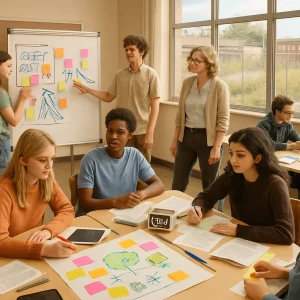
Designed for one lesson. Use this as a template: adapt context, learning goals and difficulty to your grade level.
Learning objectives (examples)
- Students will identify stakeholders and conflicting values in a civic issue.
- Students will research and propose at least two feasible community responses.
- Students will present and justify a chosen recommendation.
Materials
- Flipchart paper (one per group) + markers
- Sticky notes or Post‑its
- Student devices (optional) or printed fact sheet (teacher provides)
- Timer
- Assessment rubric (see below)
Group size and roles
- Groups of 4 (3–5 possible). Roles (rotate across lessons): Host/Facilitator, Recorder, Researcher, Presenter.
- Host stays when rotating or summarizing (if using carousel/learn‑cafe variant).
Preparation by teacher (before lesson)
- Prepare a 1‑page scenario handout (see Problem statement below).
- Prepare 2–3 short source documents or a short fact sheet (local council minutes excerpts, map, budget figures).
- Prepare flipchart sheets labelled: Stakeholders, Interests/Values, Options, Consequences.
- Print rubric and copy for quick reference.
Lesson timeline (60 minutes)
- Motivation & framing — 6 minutes
- Brief hook (photo of the green site, quick question): “Our council wants to convert the unused lot near school into either (A) a commercial parking lot, (B) a children’s park, or (C) a community garden. What should our community ask the council?”
- Share the learning goals and final product: a 3‑point recommendation and one visual flipchart.
- Problem presentation and clarifying questions — 4 minutes
- Hand out the scenario sheet and fact sheet.
- Students may ask one clarifying question (teacher answers crisply).
- Problem analysis & knowledge mapping — 12 minutes (Group work)
- Task: identify stakeholders (list on flipchart), map what each stakeholder cares about (values, constraints), and note knowledge gaps (questions to answer).
- Teacher circulates, prompts with targeted questions (see Facilitator prompts).
- Targeted research / information acquisition — 12 minutes
- Use provided fact sheets and/or online devices to find answers to key questions.
- Use MindMap technique to divide roles: who looks at budget, who looks at environmental impact, who looks at resident opinion, etc.
- Collect evidence on sticky notes.
- Outline solution options — 10 minutes
- Each group creates 2–3 viable options (e.g., mixed park + paid parking, community garden with limited parking) and lists pros/cons & likely consequences.
- Choose a recommendation and prepare a 1‑minute pitch.
- Presentations and peer feedback — 10 minutes (2–3 groups present; or Lightning round: 3 groups × 2 min)
- Each group presents 60–90 seconds. Other students write one question and one suggestion on sticky notes.
- Teacher summary and reflection — 6 minutes
- Teacher synthesizes main themes, corrects misconceptions, celebrates good civic reasoning.
- Quick formative check: Students write one sentence: “One thing I learned” + “One question I still have.”
Suggested problem statement (handout)
- “The old municipal lot next to Maple Avenue is under consideration for redevelopment. The local council proposes selling most of it to a private company to create a parking lot for new shops. Some residents propose using it as a children’s park. A third group of citizens wants a community garden with shared plots. The council asks for a community recommendation within one month. As a class advisory panel, decide what recommendation you would give the council and justify it using evidence.”
Facilitator prompts (teacher moves between groups)
- “Who are the stakeholders? Which voices are missing?”
- “What does each stakeholder value most? (safety, revenue, jobs, play space, biodiversity)”
- “What facts do you need to decide? Where will you find them quickly?”
- “What unintended consequences might your option create?”
- “Which option best balances short‑term needs and long‑term community wellbeing?”
Assessment: short supportive rubric (use formative focus)
- Criteria (use simple 3‑level descriptors): Identification of stakeholders; Use of evidence; Quality of argument (logic + trade‑offs); Teamwork/roles; Presentation clarity.
- Excellent: Clear stakeholder map, uses 2+ pieces of evidence, acknowledges trade‑offs, roles used, concise presentation.
- Satisfactory: Stakeholders noted, 1 piece of evidence, limited trade‑offs, roles partial, understandable presentation.
- Needs improvement: Missing key stakeholders, no evidence, no trade‑offs, chaotic teamwork, unclear presentation.
Differentiation options
- More time / scaffolds: Provide a template stakeholder map, sentence stems for arguments, or pre‑selected source excerpts.
- Challenge: Ask groups to draft a short vote‑friendly flyer or a one‑paragraph policy memo for the council.
- For younger students: Simplify to pros/cons and draw a picture of their recommended option.
Follow‑up / homework
- Students upload a photo of their flipchart + one‑paragraph justification to the class cloud or social group (or film their presenter pitch).
- Teacher can reuse the same case at term start and term end to measure development in reasoning (pre/post case).
Reflection prompts for class debrief
- What evidence changed your initial opinion?
- Which stakeholder(s) were easiest/hardest to represent and why?
- What civic skill did you practice today? (e.g., listening, compromise, argumentation)
Documentation & sharing
- Photograph each flipchart and store in the LMS. Encourage students to reflect in a learning journal entry (1 paragraph) linking the activity to real life.