Back to Course
Top Teacher Theory 1: W
0% Complete
0/0 Steps
-
Welcome to Top Teacher Theory7 Topics
-
How People Learn24 Topics
-
Behaviorism in practice
-
A simple lesson flow using behaviorist steps (example: multiplication fluency)
-
Cognitive approaches
-
1) Memory — the constraints and opportunities
-
2) Attention — the gatekeeper of learning
-
3) Processing — surface vs deep; serialistic vs holistic; Kolb’s cycle
-
4) Developmental & content sensitivity (Piaget + brain findings)
-
5) Metacognition and targeted learning
-
6) Social constructivism: learning together is powerful
-
7) Assessment and feedback — formative as the engine
-
8) Practical design checklist for a cognitively-smart lesson
-
9) Adapting for different learner strategies and styles
-
10) Short sample micro-lesson (45 minutes) — topic: density (ages 11–12, concrete-operational)
-
11) Five small changes you can make next lesson
-
Constructivism and active learning
-
Practical teacher moves: how to support learning-by-doing
-
Short example lesson — “Three-legged stool” (transfer-focused)
-
Sample teacher checklist for active, constructivist lessons
-
Social and motivational factors
-
Peers and group dynamics — social constructivism in practice
-
Identity, self‑concept and subject‑specific esteem
-
Motivation: intrinsic vs extrinsic (and why rewards can backfire)
-
Classroom practices — before, during and after teaching
-
Responding to the “unstable” or “rejected” student
-
Behaviorism in practice
-
Understanding Learner Development17 Topics
-
Developmental trajectories
-
From “pre-structural” to “abstract” — levels of information processing you’ll see
-
Vygotsky and social constructivism — learning is social
-
Practical classroom strategies by age band (concise)
-
Individual differences
-
Special educational needs
-
Before teaching: gather info & plan inclusively
-
During teaching: practical classroom strategies
-
Quick classroom tools (printable in your lesson kit)
-
Sample lesson modification — short example (Math: area of rectangles)
-
Teacher development: keep learning
-
Cultural and language diversity
-
Practical classroom strategies
-
Assessment: fair, supportive, and learning-focused
-
Classroom routines and small activities
-
Dealing with cultural misunderstandings and behavior differences
-
Sample mini-lesson flow (Before / During / After) — practical and brief
-
Developmental trajectories
-
Differentiation and Personalization35 Topics
-
Tiered activities and choice
-
Models of tiered activities
-
Practical, ready-to-use examples
-
Simple choice tools you can implement today
-
A simple Tiered Activity Planner (use for any lesson)
-
Assessment, feedback & grading (don’t hurt self‑esteem)
-
Troubleshooting common issues
-
Mini 45‑minute lesson plan you can try tomorrow
-
Flexible grouping
-
Data-driven grouping: a simple three-step process
-
Types of groups — choose the right one for the learning goal
-
Designing group tasks for targeted growth
-
Practical classroom routines & logistics
-
Avoiding stigma and supporting self-esteem
-
Example: a simple lesson cycle using flexible grouping
-
Dos and don’ts — at a glance
-
Universal Design for Learning (UDL)
-
Practical UDL strategies — structure by the three UDL principles
-
UDL in the lesson cycle: Before → During → After (practical checklist)
-
Mini UDL lesson template (practical, ready to copy/paste)
-
Quick adaptations for common classroom situations
-
Formative assessment & UDL — short how-to
-
EdTech for personalization
-
Practical toolbox (what to use and why)
-
Step-by-step workflow: how to design a personalized lesson with EdTech
-
Sample mini lesson flows (practical examples)
-
Metacognition and self-paced practice (student agency)
-
A short teacher checklist before you launch a personalized EdTech lesson
-
Teacher professional development & finding research / OER
-
Student agency and voice
-
Quick classroom strategies (practical, low‑prep)
-
Scaffolding agency for different students
-
Sample choice menu (middle school science)
-
Feedback language you can use (fast scripts)
-
Quick lesson‑planning checklist for agency
-
Tiered activities and choice
-
Assessment for Learning21 Topics
-
Formative assessment essentials
-
Designing formative tasks that measure metacognition (not just facts)
-
Peer and self‑assessment: routines and norms
-
Using formative data to change teaching (teacher moves)
-
Summative assessment purposefully
-
Design principles for meaningful summative assessments
-
Practical structure: before, during, after the summative
-
Making summative assessment useful for teachers
-
Quick checklist for a purposeful summative
-
Designing rubrics and criteria
-
Practical language: what a descriptor could look like
-
Using rubrics for formative vs summative purposes
-
Rubric design checklist (quick)
-
Short templates you can copy/paste
-
Using assessment data
-
Interpretations: quick rules of thumb
-
Practical step-by-step protocol (use after any assessment)
-
Using summative data to inform teaching (and be fair)
-
Conversation with students: involve them in interpreting their data
-
Short checklist for planning next steps after any assessment
-
A short sample action plan (one-page template)
-
Formative assessment essentials
-
Data-Informed Teaching and Professional Growth27 Topics
-
Learning analytics basics
-
Interpreting results — rules of thumb and actions
-
How to present feedback so it protects self‑esteem
-
Tracking competencies over time
-
Interpreting numbers: averages, dispersion, and what they tell you
-
Targeted interventions
-
Step‑by‑step: design a short targeted intervention
-
Types of short intervention plans (examples)
-
Quick templates you can copy
-
Feedback and self‑esteem — how to avoid damaging motivation
-
Teacher professional learning (short)
-
Communicating progress with stakeholders
-
Concrete formats & visuals that work
-
How to talk about results — ready scripts
-
Parent/caregiver engagement tips
-
Leader communication & professional follow‑up
-
Practical teacher checkpoints (before / during / after)
-
Action steps when dispersion (SD) is large
-
Templates you can copy/paste
-
Dos and don’ts when communicating progress
-
Building data‑informed habits (teacher checklist)
-
Reflective practice and leadership
-
A simple framework to hold in your head
-
Feedback: seeking, giving, and using it
-
Leading real change — a practical step-by-step guide
-
Templates and prompts (ready to copy)
-
Common pitfalls and how to avoid them
-
Learning analytics basics
-
Designing Competence-Focused Curriculum31 Topics
-
Learning outcomes vs objectives
-
Examples: turning objectives into outcomes
-
Align outcomes with assessment and feedback
-
Rubric elements for competence outcomes (suggested criteria)
-
Competency-based sequences
-
Core design principles (what to keep in mind)
-
Step‑by‑step routine to build a competency sequence
-
Practical tips and classroom-ready moves
-
Example: Competency progression (science) — “Run a fair experiment and interpret results”
-
Example: Competency progression (writing) — “Write a persuasive essay”
-
Designing sequences for mixed‑ability classes
-
How Piaget, Vygotsky, Kolb, Ausubel help shape sequences (short)
-
Quick checklist before you teach a sequence
-
Scaffolding and fading support
-
Types of scaffolds (practical list)
-
Sequence: from heavy support to independence
-
Example lesson snippet (middle-school science)
-
How to plan fading (practical steps)
-
Scaffolding for different prior-knowledge levels
-
Using formative assessment to guide scaffolding
-
Quick checklist for teachers (use before/during lessons)
-
Connect scaffolding to motivation and self-esteem
-
Aligning assessment and instruction
-
Step-by-step: Align instruction, practice and assessment
-
Designing assessments that measure competence (not just recall)
-
Assessing metacognitive skills
-
Formative assessment techniques (practical ideas)
-
Feedback that moves learning forward
-
Peer and self-assessment — how to train students
-
Fair grading and motivation
-
Short examples
-
Learning outcomes vs objectives
-
Feedback, Reflection and Metacognition15 Topics
-
Principles of effective feedback
-
Practical templates and sentence stems
-
How to build metacognition through feedback
-
Promoting learner reflection
-
Teaching metacognitive strategies
-
Three core moves to model (what you’ll show students)
-
Sample teacher think-aloud lines (copyable)
-
Adapting for developmental stages & learning styles
-
Formative assessment tasks that measure metacognition
-
Classroom routines & small tools you can adopt tomorrow
-
Sample 45‑minute lesson plan (metacognition embedded)
-
Sentence stems & prompts to teach explicitly (post as a poster)
-
Small collection: metacognitive activities for different ages
-
Measuring success and next steps for teachers
-
Self-assessment and goal setting
-
Principles of effective feedback
-
Classroom Practice and Management22 Topics
-
Active learning techniques
-
Routines, expectations and culture
-
Core classroom routines (with scripts you can copy)
-
Setting expectations — a step-by-step plan
-
Building a learning culture — beyond rules
-
Routines that support different learning styles & developmental stages
-
Tips for students who struggle with routine or social safety
-
Quick templates you can copy
-
Positive behavior approaches
-
Practical classroom systems and routines
-
Responsive strategies for the three student profiles
-
Scripts and micro‑dialogs (copy/paste ready)
-
Feedback and praise that builds self‑esteem
-
Quick classroom activities to build belonging and responsibility
-
A short lesson plan snippet: teaching an expectation
-
Implementation checklist (first 4 weeks)
-
Collaborative learning and peer instruction
-
Practical activities and how to run them
-
Metacognition & reflection (make it explicit)
-
Assessment: using peers without damaging reliability
-
Sample lesson fragment (20–30 min) — ready to use
-
Teacher language / prompts that work
-
Active learning techniques
-
The Capstone - Theory into Practice7 Topics
Participants 3


Lesson Progress
0% Complete
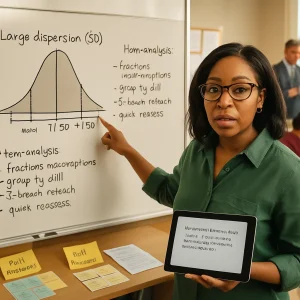
- Check the test: Were items aligned with what was taught? Any ambiguous questions?
- Look at item analysis: Are some skills systematically missed?
- Group students by the skill gap, not by ability label. Use flexible, short cycles (2–3 lessons).
- Reteach with varied methods (experiential tasks, visuals, small group practice).
- Reassess a focused set of skills (quick check) to measure growth.
Script to leaders when asking for help:
- “The assessment shows a large spread; item analysis points to misconceptions in fractions. I’ll run targeted small groups for three lessons. Could we schedule two intervention blocks next week and reassign one TA to support those groups?”
Sample feedback sentence stems (ready to use)
For growth-oriented feedback:
- “You did X well. Next, try Y because it will help you reach Z.”
- “I noticed you can [specific skill]. Let’s practice [next step] together.”
- “Great attempt — here’s one clear change that will make it better…”
For parents:
- “Your child’s recent check shows improvement in A. A small focus at home on B for 10 minutes three times this week will speed progress.”
For leaders:
- “Data shows progress overall, but variability is high. Our instructional plan: targeted reteach, quick cycle reassessment, and PLC review of item patterns.”