Back to Course
Top Teacher Theory 1: W
0% Complete
0/0 Steps
-
Welcome to Top Teacher Theory7 Topics
-
How People Learn24 Topics
-
Behaviorism in practice
-
A simple lesson flow using behaviorist steps (example: multiplication fluency)
-
Cognitive approaches
-
1) Memory — the constraints and opportunities
-
2) Attention — the gatekeeper of learning
-
3) Processing — surface vs deep; serialistic vs holistic; Kolb’s cycle
-
4) Developmental & content sensitivity (Piaget + brain findings)
-
5) Metacognition and targeted learning
-
6) Social constructivism: learning together is powerful
-
7) Assessment and feedback — formative as the engine
-
8) Practical design checklist for a cognitively-smart lesson
-
9) Adapting for different learner strategies and styles
-
10) Short sample micro-lesson (45 minutes) — topic: density (ages 11–12, concrete-operational)
-
11) Five small changes you can make next lesson
-
Constructivism and active learning
-
Practical teacher moves: how to support learning-by-doing
-
Short example lesson — “Three-legged stool” (transfer-focused)
-
Sample teacher checklist for active, constructivist lessons
-
Social and motivational factors
-
Peers and group dynamics — social constructivism in practice
-
Identity, self‑concept and subject‑specific esteem
-
Motivation: intrinsic vs extrinsic (and why rewards can backfire)
-
Classroom practices — before, during and after teaching
-
Responding to the “unstable” or “rejected” student
-
Behaviorism in practice
-
Understanding Learner Development17 Topics
-
Developmental trajectories
-
From “pre-structural” to “abstract” — levels of information processing you’ll see
-
Vygotsky and social constructivism — learning is social
-
Practical classroom strategies by age band (concise)
-
Individual differences
-
Special educational needs
-
Before teaching: gather info & plan inclusively
-
During teaching: practical classroom strategies
-
Quick classroom tools (printable in your lesson kit)
-
Sample lesson modification — short example (Math: area of rectangles)
-
Teacher development: keep learning
-
Cultural and language diversity
-
Practical classroom strategies
-
Assessment: fair, supportive, and learning-focused
-
Classroom routines and small activities
-
Dealing with cultural misunderstandings and behavior differences
-
Sample mini-lesson flow (Before / During / After) — practical and brief
-
Developmental trajectories
-
Differentiation and Personalization35 Topics
-
Tiered activities and choice
-
Models of tiered activities
-
Practical, ready-to-use examples
-
Simple choice tools you can implement today
-
A simple Tiered Activity Planner (use for any lesson)
-
Assessment, feedback & grading (don’t hurt self‑esteem)
-
Troubleshooting common issues
-
Mini 45‑minute lesson plan you can try tomorrow
-
Flexible grouping
-
Data-driven grouping: a simple three-step process
-
Types of groups — choose the right one for the learning goal
-
Designing group tasks for targeted growth
-
Practical classroom routines & logistics
-
Avoiding stigma and supporting self-esteem
-
Example: a simple lesson cycle using flexible grouping
-
Dos and don’ts — at a glance
-
Universal Design for Learning (UDL)
-
Practical UDL strategies — structure by the three UDL principles
-
UDL in the lesson cycle: Before → During → After (practical checklist)
-
Mini UDL lesson template (practical, ready to copy/paste)
-
Quick adaptations for common classroom situations
-
Formative assessment & UDL — short how-to
-
EdTech for personalization
-
Practical toolbox (what to use and why)
-
Step-by-step workflow: how to design a personalized lesson with EdTech
-
Sample mini lesson flows (practical examples)
-
Metacognition and self-paced practice (student agency)
-
A short teacher checklist before you launch a personalized EdTech lesson
-
Teacher professional development & finding research / OER
-
Student agency and voice
-
Quick classroom strategies (practical, low‑prep)
-
Scaffolding agency for different students
-
Sample choice menu (middle school science)
-
Feedback language you can use (fast scripts)
-
Quick lesson‑planning checklist for agency
-
Tiered activities and choice
-
Assessment for Learning21 Topics
-
Formative assessment essentials
-
Designing formative tasks that measure metacognition (not just facts)
-
Peer and self‑assessment: routines and norms
-
Using formative data to change teaching (teacher moves)
-
Summative assessment purposefully
-
Design principles for meaningful summative assessments
-
Practical structure: before, during, after the summative
-
Making summative assessment useful for teachers
-
Quick checklist for a purposeful summative
-
Designing rubrics and criteria
-
Practical language: what a descriptor could look like
-
Using rubrics for formative vs summative purposes
-
Rubric design checklist (quick)
-
Short templates you can copy/paste
-
Using assessment data
-
Interpretations: quick rules of thumb
-
Practical step-by-step protocol (use after any assessment)
-
Using summative data to inform teaching (and be fair)
-
Conversation with students: involve them in interpreting their data
-
Short checklist for planning next steps after any assessment
-
A short sample action plan (one-page template)
-
Formative assessment essentials
-
Data-Informed Teaching and Professional Growth27 Topics
-
Learning analytics basics
-
Interpreting results — rules of thumb and actions
-
How to present feedback so it protects self‑esteem
-
Tracking competencies over time
-
Interpreting numbers: averages, dispersion, and what they tell you
-
Targeted interventions
-
Step‑by‑step: design a short targeted intervention
-
Types of short intervention plans (examples)
-
Quick templates you can copy
-
Feedback and self‑esteem — how to avoid damaging motivation
-
Teacher professional learning (short)
-
Communicating progress with stakeholders
-
Concrete formats & visuals that work
-
How to talk about results — ready scripts
-
Parent/caregiver engagement tips
-
Leader communication & professional follow‑up
-
Practical teacher checkpoints (before / during / after)
-
Action steps when dispersion (SD) is large
-
Templates you can copy/paste
-
Dos and don’ts when communicating progress
-
Building data‑informed habits (teacher checklist)
-
Reflective practice and leadership
-
A simple framework to hold in your head
-
Feedback: seeking, giving, and using it
-
Leading real change — a practical step-by-step guide
-
Templates and prompts (ready to copy)
-
Common pitfalls and how to avoid them
-
Learning analytics basics
-
Designing Competence-Focused Curriculum31 Topics
-
Learning outcomes vs objectives
-
Examples: turning objectives into outcomes
-
Align outcomes with assessment and feedback
-
Rubric elements for competence outcomes (suggested criteria)
-
Competency-based sequences
-
Core design principles (what to keep in mind)
-
Step‑by‑step routine to build a competency sequence
-
Practical tips and classroom-ready moves
-
Example: Competency progression (science) — “Run a fair experiment and interpret results”
-
Example: Competency progression (writing) — “Write a persuasive essay”
-
Designing sequences for mixed‑ability classes
-
How Piaget, Vygotsky, Kolb, Ausubel help shape sequences (short)
-
Quick checklist before you teach a sequence
-
Scaffolding and fading support
-
Types of scaffolds (practical list)
-
Sequence: from heavy support to independence
-
Example lesson snippet (middle-school science)
-
How to plan fading (practical steps)
-
Scaffolding for different prior-knowledge levels
-
Using formative assessment to guide scaffolding
-
Quick checklist for teachers (use before/during lessons)
-
Connect scaffolding to motivation and self-esteem
-
Aligning assessment and instruction
-
Step-by-step: Align instruction, practice and assessment
-
Designing assessments that measure competence (not just recall)
-
Assessing metacognitive skills
-
Formative assessment techniques (practical ideas)
-
Feedback that moves learning forward
-
Peer and self-assessment — how to train students
-
Fair grading and motivation
-
Short examples
-
Learning outcomes vs objectives
-
Feedback, Reflection and Metacognition15 Topics
-
Principles of effective feedback
-
Practical templates and sentence stems
-
How to build metacognition through feedback
-
Promoting learner reflection
-
Teaching metacognitive strategies
-
Three core moves to model (what you’ll show students)
-
Sample teacher think-aloud lines (copyable)
-
Adapting for developmental stages & learning styles
-
Formative assessment tasks that measure metacognition
-
Classroom routines & small tools you can adopt tomorrow
-
Sample 45‑minute lesson plan (metacognition embedded)
-
Sentence stems & prompts to teach explicitly (post as a poster)
-
Small collection: metacognitive activities for different ages
-
Measuring success and next steps for teachers
-
Self-assessment and goal setting
-
Principles of effective feedback
-
Classroom Practice and Management22 Topics
-
Active learning techniques
-
Routines, expectations and culture
-
Core classroom routines (with scripts you can copy)
-
Setting expectations — a step-by-step plan
-
Building a learning culture — beyond rules
-
Routines that support different learning styles & developmental stages
-
Tips for students who struggle with routine or social safety
-
Quick templates you can copy
-
Positive behavior approaches
-
Practical classroom systems and routines
-
Responsive strategies for the three student profiles
-
Scripts and micro‑dialogs (copy/paste ready)
-
Feedback and praise that builds self‑esteem
-
Quick classroom activities to build belonging and responsibility
-
A short lesson plan snippet: teaching an expectation
-
Implementation checklist (first 4 weeks)
-
Collaborative learning and peer instruction
-
Practical activities and how to run them
-
Metacognition & reflection (make it explicit)
-
Assessment: using peers without damaging reliability
-
Sample lesson fragment (20–30 min) — ready to use
-
Teacher language / prompts that work
-
Active learning techniques
-
The Capstone - Theory into Practice7 Topics
Participants 3

Lesson 6,
Topic 3
In Progress
How to present feedback so it protects self‑esteem

didactec 10.09.2025
Lesson Progress
0% Complete
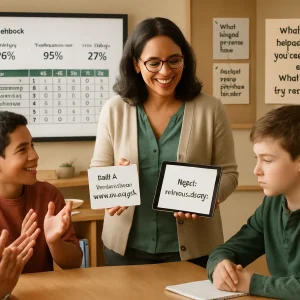
- Always start with what the student can do — build from strengths.
- Offer one clear next step, not a laundry list.
- Use formative grades as descriptors, not judgments (e.g., “Skill A: Partly — next: review strategy X”).
- Celebrate small gains publicly (group level) and give private, targeted feedback when needed.
- Encourage metacognition: ask “What helped you learn this?” and “What will you try next?”
This follows Lounaskorpi’s emphasis: strengthen self‑esteem first, then motivation and learning follow.
Avoiding common pitfalls (overload + misinterpretation)
- Don’t track everything. Choose 3 meaningful indicators and stick with them.
- Don’t confuse activity with learning. Completion ≠ understanding.
- Watch for assessment drift: “harder test than instruction” gives false signals.
- Don’t punish low confidence — use it as diagnostic information to scaffold.
- Respect privacy: anonymize data where possible, be transparent with students and parents.
Ethics & communication
- Tell students why you collect data and how it helps them.
- Ask for permission if you share identifiable data outside school.
- Use data to support learning, not label children.
- Keep parents informed about patterns and next steps — focus on growth.
Quick example: item analysis in 10 minutes
- Export quiz responses to Google Sheets.
- Create a column per question with 1 = correct, 0 = incorrect.
- Add a row at top: item difficulty = =AVERAGE(column)
- Add class average = AVERAGE(total_score_range)
- Add SD = STDEV.S(total_score_range)
- Interpret: Item difficulty under 0.6 → teach again in different way; SD > threshold (e.g., > 2 on a 10‑pt test) → mixed learning.
(If you want, I can give you an exact sample spreadsheet that does this automatically.)
Final checklist for low‑overhead learning analytics
- [ ] Pick 3 indicators for now.
- [ ] Use a simple, repeatable exit ticket every lesson.
- [ ] Automate capture (Forms/LMS) when possible.
- [ ] Analyze weekly: average, SD, item difficulty.
- [ ] Choose 1 targeted instructional move each week.
- [ ] Give feedback that builds competence and self‑esteem.
- [ ] Keep parents/students informed about growth.
Small task to try in your next lesson (5–30 minutes)
- Create a 3‑question exit ticket (use the template above).
- Collect exit tickets at the end of class.
- In Google Sheets, compute class average, confidence average, and one item difficulty.
- Decide one concrete action for the next lesson (e.g., group reteach for 4 students, or a mini‑lesson addressing the most missed item).
- Reflect: did the students’ confidence match correctness? Note one thing you’ll change.
Please take the quiz to proceed:
about:blank