
Start-of-class routine (first 3–7 minutes)

didactec 14.02.2026
Lesson Progress
0% Complete
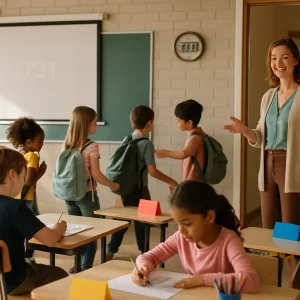
Purpose: settle students, state purpose, activate prior knowledge.
Steps (simple script and timings for a 40-minute lesson):
- Door signal (0:00) — teacher uses the agreed signal as students enter (soft chime, “Welcome”, visual card).
- Minute 1: Greeting + settle (0:00–0:30) — “Good morning. Put your bag away and find your seat.”
- Minute 1–3: Bell-ringer / Warm-up (0:30–3:00) — 2–3 quick tasks related to the lesson objective (mental maths, predict, quick drawing, recall). Example: “Solve these two number facts” or “Write one question about yesterday’s science demo.”
- Minute 3–5: Learning objective & success criteria — show the objective and one clear success criterion. “Today we will learn X. By the end you will be able to Y.”
- Minute 4–7: Materials & group reminder — “Take out your science sheet and a pencil. Groups will be the same as yesterday.”
Teacher script examples:
- Primary maths: “Take your place-value card, complete questions 1–2, then put your pencil down.”
- Secondary science: “Check you have goggles and lab sheet. Read the aim and underline the variables.”
Routines for group work
Purpose: ensure productive collaboration and clear accountability.
Core elements
- Roles (one card per student): e.g. Chair/Leader, Recorder, Materials Manager, Reporter. Rotate roles weekly.
- Clear task card: exactly what each group must do and the time allotted.
- Visible timer and noise-level expectation (silent, low, normal).
- Accountability: group poster, exit product, or quick quiz.
Steps for a group task (example 15–20 minutes)
- Set group task and outcome (1 minute). Show example.
- Assign or indicate roles (30 seconds).
- Work phase with visible timer (10–15 minutes).
- Checkpoint signal (2 minutes): teacher circulates and gives a thumbs-up or quick feedback.
- Share / report (2–3 minutes): one reporter shares main finding.
Practical tips
- Use coloured group cards or numbered desks for fast formation.
- Use a “work-on” and “present” signal (cards with icons).
- Make one member responsible for returning materials to reduce delays.
- Provide sentence stems for discussion to support language and inclusion.
Examples applied to lesson plans
- Maths station lesson: four stations (fluency, problem-solving, manipulatives, assessment). Each station has a 7-minute timer; students rotate; materials manager packs up.
- Science practical (secondary): roles include Safety Officer, Data Recorder, Equipment Manager, Presenter. Safety Officer checks goggles and protocol before starting.
- Social studies project: roles include Researcher, Designer, Scribe, Presenter. Use a gallery walk at the end for peer feedback.
Smooth transitions (between activities or spaces)
Purpose: move quickly and calmly between activities with minimum instruction.
Signals you can use
- Audio: short chime, clap pattern, recorded tune.
- Visual: countdown on screen, coloured card, flashing light.
- Verbal: “3–2–1 Transition” with clear instructions.
Transition procedure (example 30–60 second transition)
- Warning at 30 seconds left: teacher shows card and says the next step. “30 seconds — finish your sentence and put away your pencil.”
- 10-second countdown: visible timer runs. Students finish and check materials.
- Signal to move: teacher uses chime and shows the destination card. Students go directly to next station or sit ready.
Movement examples
- Whole-class to group: students stand behind chairs, turn clockwise to the next station.
- Classroom to outdoor learning: line-up order (by group), one child from each group is a line leader, teacher checks headcount.
- Equipment transition: Materials manager brings work folder to teacher trolley.
Minimise wasted time
- Have materials at stations to avoid distribution delays.
- Use a “ready” checklist for groups to self-check before teacher checks.
- Practise transitions (2–3 rehearsals) until they are quick and silent.
Ending the lesson (last 3–7 minutes)
Purpose: consolidate learning, check progress, prepare next steps.
End-of-class routine (script and tasks)
- Two-minute wrap-up: recap the objective and what was achieved.
- Exit ticket (1–3 minutes): quick formative assessment — one sentence, one problem, one question, or a quick quiz.
- Materials & tidy-up (1–2 minutes): clearly assigned tidy roles; teacher signals when complete.
- Homework & preview (30 seconds): state homework and a one-line preview of next lesson.
Exit ticket examples
- Maths: “One thing I can do now that I couldn’t before” + one sum to solve.
- Science: “Write one observation and one question about today’s experiment.”
- Social studies: “One new fact I learned + one source to check.”
End scripts
- “Everyone fill out the exit ticket. Put it in the red tray when done.”
- “Five by five: five seconds to tidy, five seconds to sit quietly for homework.”