-
From Theory to Plan: Translating Principles into Lessons4 Topics
-
Active Learning Strategies6 Topics
-
Differentiation and Personalized Learning5 Topics
-
Formative Assessment: Techniques and Use4 Topics
-
Classroom Management: Routines, Procedures and Environment5 Topics
-
Collaborative Learning and Group Work6 Topics
-
Questioning, Feedback and Scaffolding5 Topics
-
Technology Integration and Digital Activities6 Topics
-
Inclusive Practices: Equity, ELL and SEN Strategies7 Topics
-
Reflection, Action Research and Professional Growth4 Topics
Participants 3


Lesson Progress
0% Complete
Purpose
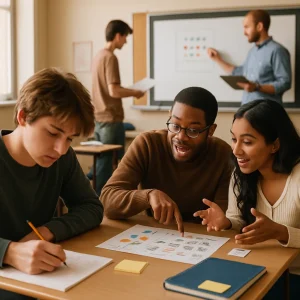
Translate the Think–Pair–Share (TPS) routine into reliable, classroom-ready pairwork and whole-class sharing.
- Show how to design TPS so it produces accountable student thinking, useful written records, and efficient whole-class synthesis.
- Provide ready-to-use examples for vocabulary practice and for a math combinatorics problem (fits your lesson topic: Calculating numbers / counting combinations).
Learning outcomes (what students should do after using TPS)
- Think: generate an individual answer or approach and record it briefly.
- Pair: explain and test their thinking with a partner; refine or extend the idea.
- Share: present a clear, concise product of the pair work to the class or submit it in written form.
- Teachers will be able to set roles, monitor pair talk, record representative solutions in OneNote/board, and use TPS variants to differentiate and assess.
When to use Think–Pair–Share
- To activate prior knowledge after homework check and before introducing new content.
- For checking conceptual understanding quickly (e.g., definitions, short proofs, step selection).
- To scaffold complex problem solving by getting students to produce and test ideas in low-stakes peer talk before whole-class exposure.
- As a formative check with minimal class rearrangement (pairs are low-cost to organize).
- Provide a short downloadable rubric / observation checklist you can use while circulating.