-
From Theory to Plan: Translating Principles into Lessons4 Topics
-
Active Learning Strategies6 Topics
-
Differentiation and Personalized Learning5 Topics
-
Formative Assessment: Techniques and Use4 Topics
-
Classroom Management: Routines, Procedures and Environment5 Topics
-
Collaborative Learning and Group Work6 Topics
-
Questioning, Feedback and Scaffolding5 Topics
-
Technology Integration and Digital Activities6 Topics
-
Inclusive Practices: Equity, ELL and SEN Strategies7 Topics
-
Reflection, Action Research and Professional Growth4 Topics
Participants 3

(F) Practical Example: Active Lesson Sequence

didactec 23.09.2025
Lesson Progress
0% Complete
 Overview
- Topic: Energy transfer (conduction, convection, radiation)
- Grade level: adaptable (upper elementary — high school) — differentiate as noted
- Duration: 50 minutes
- Big idea / competency: Students will observe and explain three modes of energy transfer and apply evidence to predict and design to control heat flow in real-life situations.
- Measurable objectives (students will be able to):
- Identify and describe conduction, convection and radiation (knowledge).
- Collect and record observations from hands-on demonstrations and station activities (skill).
- Construct a brief scientific explanation (Claim–Evidence–Reasoning) comparing modes of heat transfer and proposing one real-life application (transfer).
Materials & preparation (teacher)
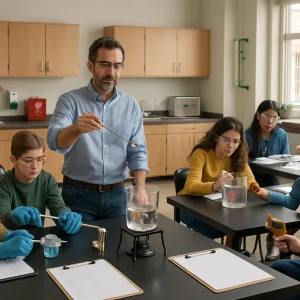
- Demo materials (teacher): metal rod or spoon, hot water in beaker, wax or small paperclips to show conduction; infrared lamp or heat lamp for radiation demo; safe hot plate or kettle (follow safety protocols).
- Station materials (for 3 stations; groups of 3–4 students — duplicate sets):
- Station A (Conduction): metal rods/spoons, wooden dowel, ice cubes, stopwatch, insulated gloves, thermometer(s), data sheet.
- Station B (Convection): clear container with water, heat source (safe low-watt kettle or hot water added), food dye or food coloring, thermometer, stirring rod, data sheet.
- Station C (Radiation): small black and white sample squares (paper), infrared lamp or desk lamp, infrared thermometer or temperature probe, cardboard shields, data sheet.
- Classroom: lab tables, clipboards, timers, large chart paper or digital whiteboard for synthesis.
- Safety: goggles, gloves, hot-water handling plan, first-aid kit. Risk assessment completed.
- Prep: set out stations before class; print student station cards with step-by-step tasks and guiding questions; assign groups or have clear grouping plan.