-
From Theory to Plan: Translating Principles into Lessons4 Topics
-
Active Learning Strategies6 Topics
-
Differentiation and Personalized Learning5 Topics
-
Formative Assessment: Techniques and Use4 Topics
-
Classroom Management: Routines, Procedures and Environment5 Topics
-
Collaborative Learning and Group Work6 Topics
-
Questioning, Feedback and Scaffolding5 Topics
-
Technology Integration and Digital Activities6 Topics
-
Inclusive Practices: Equity, ELL and SEN Strategies7 Topics
-
Reflection, Action Research and Professional Growth4 Topics
Participants 3

(B) Learning Objectives and Outcomes

didactec 23.09.2025
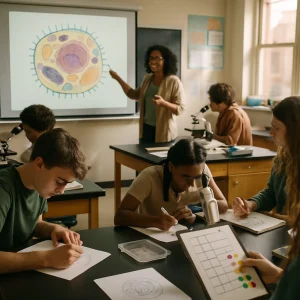
Clear, measurable learning objectives — aligned to standards and translated into student-friendly outcomes — are the backbone of lessons that reliably produce learning. In the Top Teacher lesson structure (Motivation → 10-minute teaching chunk → Activation → Reflection → Repeat/Homework), objectives guide what you teach in the brief teaching period, what activities you plan for activation, and what you assess formatively and summatively. Below is a practical guide, checklist and worked example (9th‑grade biology) you can adapt immediately.
1. Principles: What makes a good objective
Use observable, measurable language. Follow the ABCD model:
- Audience — who (the students)
- Behavior — what observable skill or product
- Condition — under what conditions or with what tools
- Degree — how well, how accurately, or how quickly
Example: “Given prepared microscope slides and a labeled diagram, students will identify and label at least 6 major organelles in plant and animal cells with 80% accuracy.”
Use measurable verbs (Bloom’s taxonomy): identify, describe, explain, classify, analyze, construct, design, evaluate, justify. Avoid vague verbs: understand, appreciate, learn, know.
Align every objective to a named standard (local/state/national or curriculum code) — or to a clear curriculum learning goal — so you can justify choices and report outcomes.
Include three types of objectives where appropriate:
- Knowledge (facts, concepts)
- Skills (procedural, experimental, cognitive)
- Dispositions / 21st‑century skills (collaboration, scientific thinking, communication)
2. Translate objectives into student‑friendly outcomes
Students remember and work toward outcomes framed as “I can…” or “By the end of this lesson I will be able to…”.
Teacher objective:
- “Students will explain photosynthesis.”
Student‑friendly outcome:
- “By the end of this lesson I can explain how plants use sunlight to make sugar and list the reactants and products of photosynthesis.”
Always pair outcomes with success criteria that define proficiency (the Degree in ABCD). Example success criteria for the “I can” above:
- Lists at least the two reactants and two products
- Draws a labelled diagram showing where photosynthesis occurs
- Explains the role of light energy in two sentences
3. Checklist for writing objectives & outcomes
- [ ] Aligned to a named curriculum standard or unit goal
- [ ] Uses an observable verb (see verbs list below)
- [ ] Contains condition and degree (ABCD)
- [ ] Includes at least one skill-based outcome (not only fact recall)
- [ ] Has a student‑friendly translation (“I can…”)
- [ ] Includes success criteria (how to know it’s achieved)
- [ ] Has at least one formative check you will use during class
- [ ] Has summative evidence planned (test, performance, project, portfolio)
Useful measurable verbs (not exhaustive): list, label, describe, calculate, compare, contrast, predict, design, construct, explain, justify, analyze, measure, interpret, evaluate, create.
Do NOT use: understand, learn, appreciate, know (without operationalizing).
4. Mapping objectives to the lesson structure
- Motivation (first ~5 min)
- State the objective in student‑friendly language and connect to real life.
- Quick diagnostic: one or two questions to determine starting level (preconception test, thumbs up/down, 3-2-1).
- Teaching chunk (max 10 min)
- Teach content strictly necessary to meet the objective. Use worked examples tied to the success criteria.
- Activation (practice & exploration)
- Activities designed specifically to produce evidence for the objectives (microscope stations, data collection, concept mapping, peer teaching).
- Include differentiation options linked to the same objective.
- Reflection (capture and correct)
- Students report what they can now do (Information Ladder, 3-2-1, one-minute round).
- Teacher corrects misconceptions immediately.
- Repeat / Homework (consolidation)
- Short tasks that require recall and application (low-stakes retrieval practice aligned to success criteria).
Formative checks should be quick, frequent and linked to objectives: mini whiteboard responses, exit tickets, rubrics during group work, short quizzes (Socrative, Kahoot), or observation checklists.
Summative assessment must measure the same behaviors named in objectives and provide equitable accommodations (extra time, quieter place, different format) as described in your policy.
5. Worked example — 9th‑grade biology lesson
Topic: Cell Structure & Function (one 45–60 minute lesson)
Curriculum alignment (example)
- National/Local Standard: Biology 9 — Cells and Cellular Processes (or replace with your local code)
- Unit goal: Students will understand the structure and function of major cell organelles and be able to explain their roles in cell survival.
Lesson-level measurable objectives (ABCD style)
- Knowledge objective
- Given microscope slides and labeled diagrams (Condition), students (Audience) will identify and label (Behavior) at least 6 major organelles (nucleus, mitochondrion, chloroplast, cell membrane, cell wall, vacuole) in plant and animal cells (Degree) with ≥ 80% accuracy.
- Skill objective (investigative)
- Given a prepared investigation and sensor data or observation checklist, students will compare and record (Behavior) differences in structure between plant and animal cells (Condition) and construct (Behavior) a comparative table and one labelled sketch that correctly attributes three structural differences (Degree).
- Scientific explanation objective (higher cognitive/communication)
- Using evidence from microscope observations and textbook diagrams (Condition), students will explain (Behavior) how at least two organelles contribute to energy production and use (mitochondria and chloroplasts) (Audience) in a written paragraph that includes one claim, one piece of evidence and one explanation (Degree).
Student‑friendly outcomes (to display at start)
- “By the end of this lesson I can:
- identify and label the major organelles in plant and animal cells,
- make a clear table comparing plant and animal cell structures,
- explain how mitochondria and chloroplasts help cells get energy (and support that explanation with evidence).”
Success criteria (make visible)
- Identification: 6 organelles correctly labelled on a diagram or slide (≥80% correct)
- Comparison: Table includes at least 3 accurate structural differences and one example of where each is found
- Explanation: Paragraph uses claim–evidence–reasoning format; evidence cites an observation or diagram; reasoning connects organelle structure to function
Formative checks and where they fit in the lesson
- Motivation (5 min)
- Quick diagnostic: show two cell images — students write one observable difference on a sticky note (preconception check).
- State outcomes and success criteria (connect to real world: “why do plant cells need chloroplasts?”).
- Teaching chunk (10 min)
- Brief direct instruction with annotated diagrams and one worked example (label a slide together).
- Ask 2 targeted cold-call questions (retrieve & check).
- Activation (20–25 min)
- Microscope stations (or virtual microscope) — students identify organelles and complete a labeling worksheet (measures objective 1).
- Pair work: build comparative table and sketch; teacher circulates with a checklist rubric (measures objective 2).
- Extension: small group prepares one 2‑minute explanation of energy organelles using claim–evidence–reasoning (measures objective 3).
- Reflection (5–8 min)
- Information ladder / Exit ticket: “After this lesson I 1) know ___ 2) understand ___ 3) can use this info ___ 4) noticed ___.”
- Teacher collects exit tickets to adjust next lesson (formative data).
- Homework
- Short retrieval assignment: label a blank cell diagram (3 minutes), and write one Claim–Evidence–Reasoning sentence about energy organelles.
Summative evidence options (choose one or combine)
- Short lab report (group): embedded microscope images, table of differences, CER paragraph (graded with rubric).
- Practical performance task: label an unlabeled slide under time & produce a 3‑minute oral explanation.
- End-of-unit quiz: multiple choice (identification), short answer (compare), one CER paragraph (explain).
Sample rubrics (brief)
Identification rubric (6 points total)
- 6 correct = Proficient (6)
- 4–5 correct = Developing (4–5)
- 0–3 correct = Beginning (0–3)
CER paragraph rubric (4‑point)
- 4 — Claim clearly stated, evidence linked to observation, reasoning explains structure→function precisely
- 3 — Claim + evidence present, reasoning present but limited
- 2 — Claim + weak or irrelevant evidence, weak reasoning
- 1 — Claim only or incomplete
Accommodations for summative assessment (apply per student needs)
- Extra time, quieter environment, scribe for written tasks, alternative formats (oral explanation or recorded video), simplified language for prompts — all should still measure the same behavior (identify, compare, explain).
Differentiation ideas linked to objectives
- Struggling learners: scaffolded labels (word bank), paired with an expert peer, allow use of labeled diagrams during formative checks.
- Advanced learners: ask to predict how organelle function changes under stress (e.g., low light), or design a simple experiment to test chloroplast activity (photosynthesis proxy).
6. Quick teacher templates
Objective template (ABCD)
- “Given __ (condition), students will __ (behavior) __ (content) with __ (degree). Standard: __.”
Student outcome template
- “By the end of this lesson I can __ (student‑friendly behavior/condition/degree). Success criteria: __.”
Formative check choices (use one or more)
- Mini whiteboard label (identification)
- Two‑minute paired explanation (communication)
- Information Ladder (reflect)
- Concept map or mind map (structure)
- Short multiple‑choice (diagnostic)
- Rubric checklist during station work (skill)
7. Common pitfalls and how to avoid them
- Pitfall: Objectives that use non‑measurable verbs (e.g., “understand”). Fix: Replace with specific observable task (explain, list, apply).
- Pitfall: Objectives that are too broad for a single lesson. Fix: Reduce to one or two focused outcomes for the lesson; reserve larger tasks for units.
- Pitfall: No alignment between formative tasks and objectives. Fix: Design activation tasks explicitly to produce evidence for the named behaviors.
- Pitfall: No success criteria visible to students. Fix: Always display “I can” statement and success criteria at the start and revisit in reflection.
8. Final checklist before you teach
- Objectives written in ABCD form and aligned to standards
- Student‑friendly “I can” outcome and visible success criteria
- Teaching chunk planned to the point — no more than 10 minutes of direct instruction
- Activation tasks that produce observable evidence for each objective
- Formative checks and quick feedback loops planned
- Summative evidence defined with rubric/checklist and accommodations ready
- Reflection and repetition activity prepared for end of lesson
- Materials & assessment templates saved for reuse and revision
Using this approach turns curriculum content into precise plans you can teach in short, high‑impact chunks; students will know exactly what success looks like; your formative and summative assessments will measure the right things; and you will be able to refine the lesson after each delivery. Save the objectives, student outcomes and rubrics in your lesson notebook (OneNote or LMS) so each subsequent year you only tweak, not redesign.